Wednesday, May 21, 2025

Maintenance Methods for Universal Joint Couplings
 

Maintenance Methods for Universal Joint Couplings

来源:https://www.timothyholding.com作者:Timothy Couplings网址:https://www.timothyholding.com/Maintenance-Methods-for-Universal-Joint-Couplings.html
文章附图

Maintenance Methods for Universal Joint Couplings


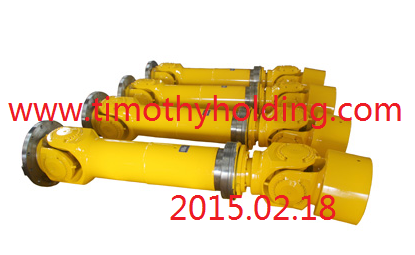
Universal joint couplings are widely used in various industries including metallurgical machinery, heavy machinery, petroleum machinery, construction machinery, lifting and transportation equipment, railway vehicles, light industrial machinery, precision machinery, and control systems for transmitting torque in mechanical shaft systems.


Assembly Techniques:

1.Preparation:

oRemove all burrs and clean all components thoroughly before assembly.

2.Alignment:

oEnsure the bearing hole centerlines of the two intermediate welded yokes are on the same plane during assembly, with a maximum deviation not exceeding 1°.

oThe spline section should slide smoothly, and the joint should rotate freely.

3.Surface Treatment:

oClean all surfaces.

oApply anti-rust grease to the flange end faces and keyways.

oApply one coat of anti-rust primer to the remaining surfaces, followed by spray painting (brushing is not recommended).

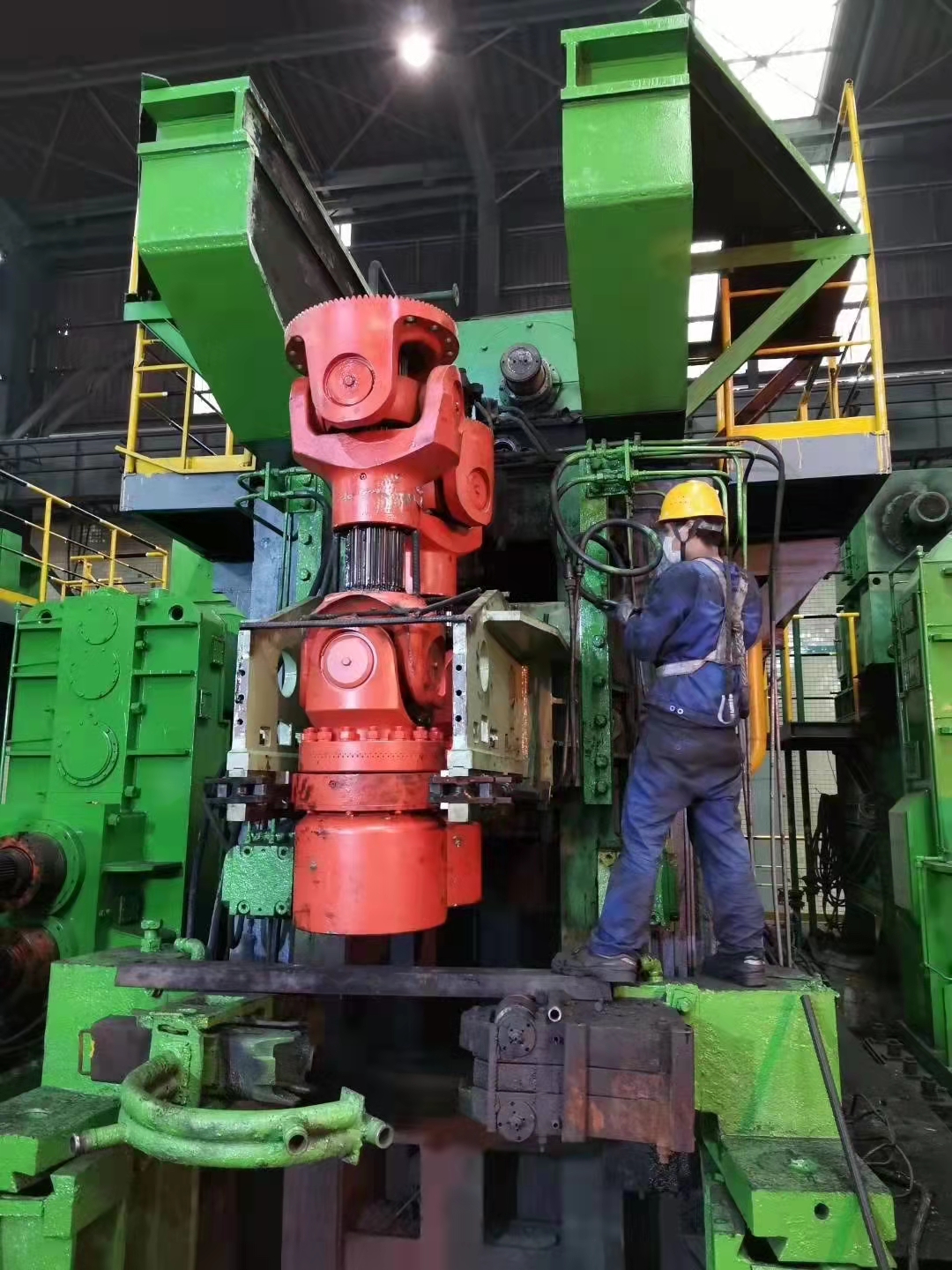
cardan shaft for rolling mill.jpg

Maintenance Methods:

1.Regular Lubrication:

oStandard conditions: Lubricate weekly.

oHigh-temperature conditions: Lubricate daily.

oUse recommended lubricants suitable for the operating environment.


2.Extended Service Life:

oRotate the cross shaft by 180° during each disassembly to ensure alternating use of the cross shaft journals, promoting even wear distribution.

Structural Varieties:

Universal joint couplings are available in multiple structural types, with the key features being:

•Large angular compensation capability

•Compact design

•High transmission efficiency


Common types include:

1.Cross Shaft Type (Most commonly used)

2.Ball Cage Type

3.Ball Fork Type

4.Lug Type

5.Ball Pin Type

6.Ball Joint Type

7.Ball Joint Plunger Type

8.Three-Pin Type

9.Three-Arm Type

10.Three-Ball Pin Type

11.Hinged Lever Type

Each type is categorized into heavy-duty, medium-duty, light-duty, and small-duty based on the torque transmission requirements.


Key Maintenance Points:

•Inspection Frequency: Monthly for standard applications, weekly for high-load or high-speed operations

•Lubricant Selection: Use high-temperature grease for elevated temperature environments

•Wear Monitoring: Check for play or backlash during routine maintenance

•Alignment Verification: Confirm proper alignment during seasonal maintenance

Proper maintenance following these guidelines will ensure optimal performance and extended service life of universal joint couplings in various industrial applications.

https://www.timothyholding.com/Maintenance-Methods-for-Universal-Joint-Couplings.html


Sunday, May 4, 2025

Universal Joint Couplings as Critical Mechanical Transmission Components

 Universal Joint Couplings as Critical Mechanical Transmission Components

Fundamental Role in Power Transmission

Universal joint couplings serve asessential components in mechanical power transmission systems, widely employedin:

  • Automotive     systems

  • Lifting     and transportation equipment

  • Construction     machinery

  • Industrial     machinery

    Universal joint couplings.png

Common Types of Constant Velocity Joints

  1. Rzeppa (Ball-type) Joints

  2. Double Cardan Joints

  3. Cross-slider Couplings

  4. Disc-type Couplings

These are particularly suitable forconnecting:

  • Intersecting     shafts

  • Parallel     shafts

  • Providing     constant velocity transmission

Advanced Spatial Mechanism Applications

Recent research has developed specializeduniversal joint designs for:

  • Direct     connection of spatial intersecting shafts

  • Large-angle     intersecting shaft connections (with wide variable range)

  • Simplified     manufacturing with fewer components

Critical Application Case: Tube RollingMills

In rolling mill main drive systemsconsisting of:

  • Main     motor

  • Reducer

  • Connecting     shaft

  • Universal     joint coupling

The universal joint coupling represents themost vulnerable mechanical component, where traditional design approaches facedlimitations:

Traditional Design Limitations

  1. Engineering Mechanics     Methods

    • Limited accuracy

    • Poor reliability

  2. Empirical Formula Methods

    • Based on experimental data

    • Required large safety factors

    • Resulted in oversizing and higher costs

Modern Computational Analysis Advancements

With computer technology development,numerical analysis methods have revolutionized design:

Finite Element Method (FEM) Advantages

  • Powerful     computational mathematics approach

  • Widely     adopted in metallurgical equipment design

  • Particularly     effective for complex components like universal joints

  • Provides     practical, reliable and convenient analysis

Modeling Optimization Techniques

Key simplifications in FEM modeling:

  1. Focus on Critical     Components

    • Primarily analyzing the yoke head

    • Simplified modeling of roll-end components

  2. Contact Simulation

    • Independent modeling of:

      • Yoke

      • Jaw

      • Roll-end flange

    • Creation of contact pairs to simulate force transmission

  3. Reasonable Simplifications

    • Ignoring non-load-bearing bolts

    • Omitting minor fillets and rounds

    • Eliminating rigid body displacement

Performance Enhancement Strategies

  1. Precision Manufacturing

    • Improved component geometry

    • Enhanced surface finishes

  2. Material Optimization

    • Advanced alloy selection

    • Heat treatment processes

  3. Maintenance Considerations

    • Lubrication system design

    • Wear monitoring techniques


https://www.timothyholding.com/Universal-Joint-Couplings-Transmission-Components.html

cardan shafts with couplings

 cardan shafts with couplings for steel industry equipment


Material:35CrMo and 20CrMnTi


https://www.timothyholding.com/cardan-shafts-with-couplings.html


steel industry equipment.jpg

Nuclear Power Plant

Puncher

Steekle mill

Straightening machine

Thursday, January 23, 2025

SWC225BF Cardan Shaft


SWC225BF Cardan Shaft

SWC225BF Cardan Shaft


Material:35CrMo and 20CrMnTi


Largely used in rolling mills,Pipe straighteners,Steel mill,tube mill,Continuous casting machinery,Paper machines ,Piercing mills,Bridge cranes,Steckel mill,Punchers,Roller conveyor, Rotating furnace,Mining machinery and other heavy duty machinery .


Contact Name:August

Mobile Phone:+86-13758897904

E :august@timothyholding.com

Web:www.timothyholding.com

Address:55# Jinshi Road ,Lecheng Industrial Park,Yueqing City,Zhejiang provice,China


Sunday, September 8, 2024

Rolling Process For Steel


Rolling Process For Steel


文章附图

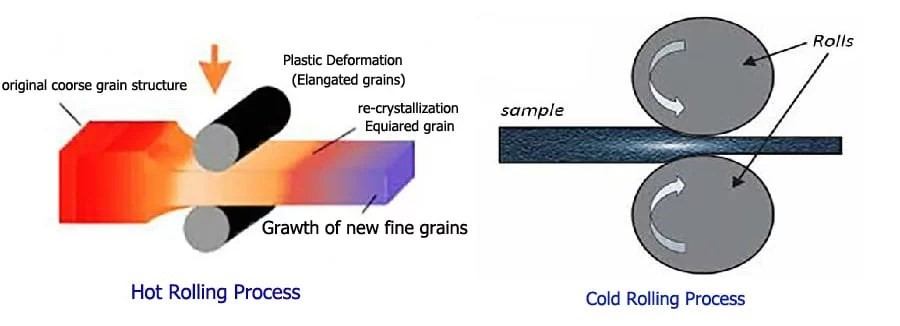
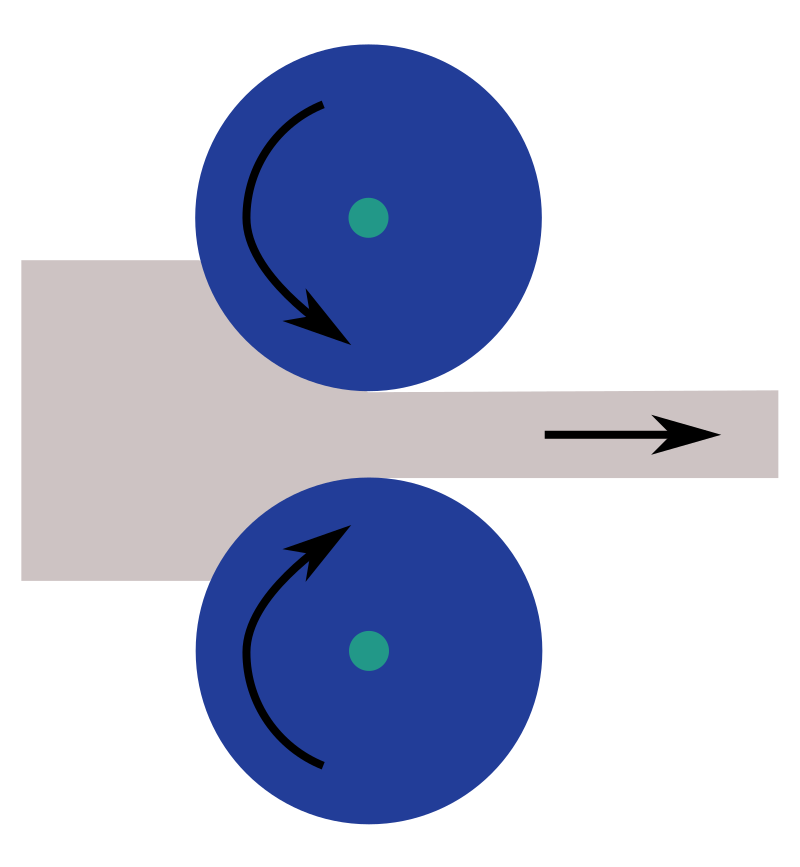
Steel undergoes the process of rolling to reduce the thickness of the metal as well as make it uniform. In this process, steel is placed between two/multiple rolls where the thickness is altered by manipulating the length direction of the steel rather than the width direction. This is because the point of contact between rolls along the length is much smaller than the width of the steel sheet that is pushed in between. This makes sure that the length of the steel is worked on and the working of the roll along the width is restrained.


Types of rolling

There are two types of rolling process: hot and cold rolling process. The basic distinction between these two processes is the difference in the processing temperature with regards to the recrystallization of the steel. When the processing temperature of the deformation of steel is above the recrystallization temperature, it hot rolling. On the other hand, if the processing temperature is below the recrystallization temperature, it is cold rolling.

Hot rolling process


It makes the steel soft and ductile. The hardness of steel cannot be modified after the hot rolling process. The hardness is related to chemical composition of the metal as well as the rate of cooling. Hot rolling, however, may lead to loss of steel because of oxidation and result in poor surface finish.


Cold rolling process


In case of cold rolling, the hardness is much more than the hot rolling process. This process helps to obtain physical qualities of metal that are usually not obtainable by the hot rolling process. This can eliminate the errors like that of shrinkage. In short, cold rolling results in a final metal sheet that is more accurate in terms of dimensions and properties than the one that is obtained from hot rolling process. The metal sheet has a smoother surface and the strength of the steel is also increased. However, the ductility decreases. The strain makes the steel more brittle. Further, the final metal obtained needs to undergo heating regularly to make it workable.

swc cardan shafts (1).jpg

The basic of rolling process of steel


Both horizontal and vertical stresses caused by the rolls compresses as well as restrain the steel. The rolls exert a vertical stress on the piece of steel and at the same time the price of metal exerts pressure back on the rolls. The rolls are exposed to elastic deformation because of the pressure induced by the piece of metal.

It leads to uneven distribution of thickness of the steel in such a way that the thickness is greater in the center and reduces as it moves along the edges of the metal. A thicker center indicates that the edges of the steel are more elongated. This implies that the edges are subjected to more stress and there is also more tension in the center of the working metal. The uneven thickness can lead to flawed final sheet of steel. It can cause warping, cracking or wrinkling of the steel sheet.

To counter this, back-up rolls are used. Otherwise, you can also use materials like sintered carbide that are high elastic modulus. Sometimes, cambered rolls are also used to counter elastic deflection of rolls. Depending upon the width of steel involved in the rolling and the stress flow, the degree of cambering can be decided. Insufficient cambering or absence of cambering can result in steel that has thicker center. On the other hand, if over cambering happens, it will make the edges thicker than center, which just the exact opposite of insufficient cambering. This can lead to splitting, wrinkling and cracking of edges of the final sheet of steel.

Contact Name:August

Mobile Phone:+86-13758897904

E :august@timothyholding.com

Web:www.timothyholding.com

Address:55# Jinshi Road ,Lecheng Industrial Park,Yueqing City,Zhejiang provice,China

Saturday, August 3, 2024

Universal Joint Shaft for Ladle Crane

 Universal Joint Shaft for Ladle Crane


Universal joint shaft / Industrial cardan drive shaft used in 480t ladle crane for Ma’anshan Steel


Material:35CrMo and 20CrMnTi


Cardan shaft

Cardan joint shaft


Contact Name:August

Mobile Phone:+86-13758897904

E :august@timothyholding.com

Web:www.timothyholding.com

Address:55# Jinshi Road ,Lecheng Industrial Park,Yueqing City,Zhejiang provice,China

Tuesday, July 30, 2024

Sunday, July 28, 2024

Industrial Cardan Shafts for Hot Rolling Mills

 Industrial Cardan Shafts for Hot Rolling Mills


Material:35CrMo and 20CrMnTi


Industrial Cardan Shafts for Hot Rolling Mills


Universal shafts

Cardan shaft couplings

Contact Name:August


Mobile Phone:+86–13758897904

E :august@timothyholding.com

Web:www.timothyholding.com

Address:55# Jinshi Road ,Lecheng Industrial Park,Yueqing City,Zhejiang provice,China

Thursday, July 25, 2024