Showing posts with label steel industry. Show all posts

Sunday, September 8, 2024

Rolling Process For Steel
 

Rolling Process For Steel


文章附图

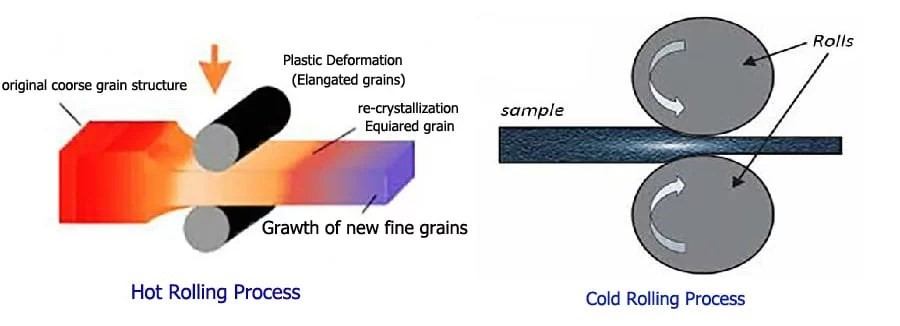
Steel undergoes the process of rolling to reduce the thickness of the metal as well as make it uniform. In this process, steel is placed between two/multiple rolls where the thickness is altered by manipulating the length direction of the steel rather than the width direction. This is because the point of contact between rolls along the length is much smaller than the width of the steel sheet that is pushed in between. This makes sure that the length of the steel is worked on and the working of the roll along the width is restrained.


Types of rolling

There are two types of rolling process: hot and cold rolling process. The basic distinction between these two processes is the difference in the processing temperature with regards to the recrystallization of the steel. When the processing temperature of the deformation of steel is above the recrystallization temperature, it hot rolling. On the other hand, if the processing temperature is below the recrystallization temperature, it is cold rolling.

Hot rolling process


It makes the steel soft and ductile. The hardness of steel cannot be modified after the hot rolling process. The hardness is related to chemical composition of the metal as well as the rate of cooling. Hot rolling, however, may lead to loss of steel because of oxidation and result in poor surface finish.


Cold rolling process


In case of cold rolling, the hardness is much more than the hot rolling process. This process helps to obtain physical qualities of metal that are usually not obtainable by the hot rolling process. This can eliminate the errors like that of shrinkage. In short, cold rolling results in a final metal sheet that is more accurate in terms of dimensions and properties than the one that is obtained from hot rolling process. The metal sheet has a smoother surface and the strength of the steel is also increased. However, the ductility decreases. The strain makes the steel more brittle. Further, the final metal obtained needs to undergo heating regularly to make it workable.

swc cardan shafts (1).jpg

The basic of rolling process of steel


Both horizontal and vertical stresses caused by the rolls compresses as well as restrain the steel. The rolls exert a vertical stress on the piece of steel and at the same time the price of metal exerts pressure back on the rolls. The rolls are exposed to elastic deformation because of the pressure induced by the piece of metal.

It leads to uneven distribution of thickness of the steel in such a way that the thickness is greater in the center and reduces as it moves along the edges of the metal. A thicker center indicates that the edges of the steel are more elongated. This implies that the edges are subjected to more stress and there is also more tension in the center of the working metal. The uneven thickness can lead to flawed final sheet of steel. It can cause warping, cracking or wrinkling of the steel sheet.

To counter this, back-up rolls are used. Otherwise, you can also use materials like sintered carbide that are high elastic modulus. Sometimes, cambered rolls are also used to counter elastic deflection of rolls. Depending upon the width of steel involved in the rolling and the stress flow, the degree of cambering can be decided. Insufficient cambering or absence of cambering can result in steel that has thicker center. On the other hand, if over cambering happens, it will make the edges thicker than center, which just the exact opposite of insufficient cambering. This can lead to splitting, wrinkling and cracking of edges of the final sheet of steel.

Contact Name:August

Mobile Phone:+86-13758897904

E :august@timothyholding.com

Web:www.timothyholding.com

Address:55# Jinshi Road ,Lecheng Industrial Park,Yueqing City,Zhejiang provice,China

Thursday, July 4, 2024

Market Trends of the Steel Industry

 Market Trends of the Steel Industry


Web::www.timothyholding.com/Market-Trends-of-the-Steel-Industry.html

Introduction

The steel industry is a cornerstone of the global economy, playing a critical role in various sectors including construction, automotive, infrastructure, and manufacturing. As the world continues to evolve, so too does the steel industry, driven by technological advancements, changing market demands, and sustainability considerations. This article explores the current market trends and future prospects of the steel industry, providing a comprehensive overview of its trajectory in the coming years.

Current Market Trends

1. Technological Advancements

Technological innovation is at the heart of the steel industry's evolution. The integration of advanced technologies such as artificial intelligence (AI), machine learning (ML), and the Internet of Things (IoT) is transforming steel production processes, enhancing efficiency, and reducing costs. For instance, smart sensors and automation are improving predictive maintenance, reducing downtime, and optimizing production lines.

Additionally, digital twins – virtual replicas of physical assets – are being used to simulate and optimize steel production processes. This technology enables steel manufacturers to predict potential issues and optimize operations, leading to increased productivity and reduced waste.

2. Sustainability and Green Steel

Environmental concerns are reshaping the steel industry, with a growing emphasis on sustainability and reducing carbon footprints. The concept of "green steel" is gaining traction, referring to steel produced with minimal environmental impact. Companies are investing in research and development to create steel using renewable energy sources and innovative production methods, such as hydrogen-based steelmaking.

The European Union's Green Deal and similar initiatives worldwide are pushing the industry towards greener practices. Carbon capture and storage (CCS) technologies are also being explored to reduce emissions from traditional steel production processesIndustrial propeller shaft.jpg

3. Shift towards High-Strength, Lightweight Steel

As industries such as automotive and aerospace seek to improve fuel efficiency and reduce emissions, there is an increasing demand for high-strength, lightweight steel. Advanced High-Strength Steel (AHSS) and Ultra High-Strength Steel (UHSS) are becoming more prevalent, offering superior strength-to-weight ratios. These materials are essential for manufacturing lighter vehicles and structures without compromising safety and durability.

4. Global Trade Dynamics

The steel industry is heavily influenced by global trade policies and economic conditions. Tariffs, trade agreements, and geopolitical tensions can significantly impact steel prices and availability. For example, the trade war between the United States and China has led to fluctuating steel prices and disrupted supply chains.

In response, many countries are adopting protectionist measures to safeguard their domestic steel industries. This has led to the localization of steel production and a reevaluation of global supply chains to mitigate risks associated with trade uncertainties.

5. Demand from Emerging Markets

Emerging markets, particularly in Asia and Africa, are driving the demand for steel. Rapid urbanization and industrialization in countries like India, Indonesia, and Nigeria are leading to increased construction activities and infrastructure development. This growing demand from emerging economies is a crucial driver for the global steel industry's expansion.


Contact Name:August

Mobile Phone:+86-13758897904

E :august@timothyholding.com

Web:www.timothyholding.com

Address:55# Jinshi Road ,Lecheng Industrial Park,Yueqing City,Zhejiang provice,China

Future Prospects of the Steel Industry

 Future Prospects of the Steel Industry


Web::www.timothyholding.com/Future-Prospects-of-the-Steel-Industry.html


1. Sustainable Production Methods

The future of the steel industry is closely tied to its ability to adopt sustainable production methods. The transition to low-carbon and zero-carbon steel production is imperative to meet global climate goals. Hydrogen-based steelmaking, which replaces carbon with hydrogen in the reduction process, holds significant promise. If commercialized at scale, it could drastically reduce the industry's carbon footprint.

Moreover, recycling and circular economy practices are expected to play a larger role. Increasing the use of scrap steel in production can reduce the need for virgin raw materials and decrease overall energy consumption. Enhanced recycling techniques and the development of new recycling technologies will be crucial for achieving sustainability targets.


2. Advanced Materials and Innovation

Innovation in materials science will continue to drive the steel industry forward. Researchers are exploring new steel alloys with enhanced properties, such as increased corrosion resistance, higher strength, and improved formability. These advanced materials will find applications in various industries, from construction to aerospace, where performance and durability are critical.

Furthermore, nanotechnology is expected to revolutionize steel production. Nano-engineered steels can offer superior strength, toughness, and wear resistance, opening up new possibilities for their use in extreme environments and high-performance applications.


3. Digital Transformation

Digital transformation will remain a key trend in the steel industry. The adoption of Industry 4.0 technologies, such as AI, IoT, and big data analytics, will continue to optimize production processes and supply chain management. Predictive analytics will enable manufacturers to anticipate market demand and adjust production accordingly, reducing excess inventory and minimizing waste.

Additionally, blockchain technology has the potential to enhance transparency and traceability in the steel supply chain. By providing a secure and immutable record of transactions, blockchain can help prevent fraud, ensure product quality, and streamline logistics.

4. Urbanization and Infrastructure Development

The ongoing urbanization and infrastructure development, particularly in emerging markets, will be a significant driver of steel demand. As populations grow and cities expand, the need for residential, commercial, and industrial infrastructure will increase. Steel will remain a fundamental material for constructing buildings, bridges, railways, and other critical infrastructure.

Governments around the world are also investing in large-scale infrastructure projects to stimulate economic growth and improve living standards. These projects, including smart cities and sustainable transportation systems, will further boost the demand for steel.

350-cardan shaft.jpg

5. Circular Economy and Resource Efficiency

The steel industry is expected to embrace the principles of the circular economy more fully. This involves designing products for longevity, reuse, and recyclability. By minimizing waste and maximizing resource efficiency, the industry can reduce its environmental impact and create new business opportunities.

Product-as-a-service models, where steel products are leased rather than sold, are gaining traction. This approach encourages manufacturers to design durable products that can be easily maintained and recycled, fostering a more sustainable and resource-efficient industry.


Conclusion:

The steel industry is at a pivotal moment, shaped by technological advancements, sustainability initiatives, and evolving market demands. As it navigates these changes, the industry's ability to innovate and adapt will be crucial for its future success. By embracing sustainable practices, investing in advanced materials, and leveraging digital technologies, the steel industry can continue to thrive and play a vital role in the global economy.

The future prospects of the steel industry are promising, with significant opportunities for growth and development. As the world moves towards a more sustainable and technologically advanced future, the steel industry will remain a cornerstone of progress, driving innovation and supporting the infrastructure and industries that underpin modern society.


Contact Name:August

Mobile Phone:+86-13758897904

E :august@timothyholding.com

Web:www.timothyholding.com

Address:55# Jinshi Road ,Lecheng Industrial Park,Yueqing City,Zhejiang provice,China