Showing posts with label pto shaft coupling. Show all posts

Monday, June 30, 2025

Application Scope of GICL & GIICL Series Drum Gear Couplings
Application Scope of GICL & GIICL Series Drum Gear Couplings

文章附图

Application Scope of GICL & GIICL Series Drum Gear Couplings


1. Overview

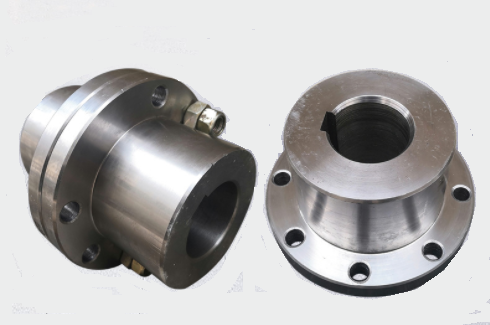
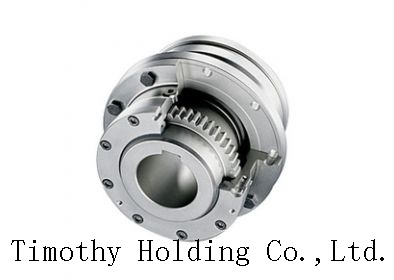
Drum gear couplings (rigid flexible couplings) consist of internal gear rings and flanged half-couplings with external teeth, both sharing identical tooth counts. The external teeth are categorized as straight teeth or drum-shaped teeth. Compared to straight-tooth designs, drum-shaped teeth enable:

•Larger angular displacement tolerance

•Improved tooth contact conditions

•Enhanced torque transmission capacity

•Extended service life

GIICL drum gear coupling.jpg

2. Technical Features of GICL/GIICL Series

•Optimized for low-speed, heavy-load conditions

•Robust construction with high misalignment compensation (axial, radial, angular)

•Sealed lubrication system to minimize wear and ensure stable performance


3. Key Applications

GICL/GIICL series couplings are widely used in industries requiring reliable heavy-duty power transmission, including:

•Metallurgy: Rolling mills, blast furnace equipment

•Mining: Crushers, conveyors, hoisting systems

•Material Handling: Cranes, winches, heavy-duty transporters

•Petrochemical: Pumps, compressors, agitators

•General Machinery: High-torque drives in manufacturing and processing systems


4. Industry Advantages

•Durability: Designed to withstand harsh environments (shock loads, vibrations, temperature variations).

•Versatility: Suitable for both horizontal and vertical shaft configurations.

•Maintenance Efficiency: Modular design simplifies inspection and replacement.


https://www.timothyholding.com/Application-of-GICL-GIICL-Drum-Gear-Couplings.html

Wednesday, June 4, 2025

Drum Gear Coupling Models, Standards, and Performance Overview


Drum Gear Coupling Models, Standards, and Performance Overview

Timothy Coupling
文章附图

Drum Gear Coupling Models, Standards, and Performance Overview

1. GICL Series (JB/T8854.3-2001)

· Model: GICL

Application: Connects two horizontally aligned shafts with angular misalignment compensation.

Rated Torque: 0.8–3,200 kN·m

Operating Temp.: -20°C to +80°C

· Model: GICLZ (Extended Shaft Version)

Application: Same as GICL but for longer shaft distances.

Rated Torque: 0.8–3,200 kN·m

Operating Temp.: -20°C to +80°C

2. GIICL Series (JB/T8854.2-2001)

· Model: GIICL

Application: Horizontal shaft connection with angular and radial displacement compensation.

Rated Torque: 0.4–4,500 kN·m

Operating Temp.: -20°C to +80°C

· Model: GIICLZ (Extended Shaft Version)

Application: Long-distance shaft connections with misalignment tolerance.

Rated Torque: 0.4–4,500 kN·m

Operating Temp.: -20°C to +80°C

3. GCLD Series (JB/T8854.1-2001)

· Model: GCLD

Application: Connects motors to machinery with angular misalignment compensation.

Rated Torque: 1.12–50 kN·m

Operating Temp.: -20°C to +80°C

4. NGCL Series (JB/ZQ4644-97)

· Model: NGCL (Brake Wheel Type)

Application: Horizontal shaft connection with integrated braking system.

Rated Torque: 355–100,000 N·m

5. TGL Series (JB/T5514-91)

· Model: TGL

Application: General-purpose shaft connection with elastic displacement compensation.

Rated Torque: 10–2,500 N·m

Operating Temp.: -20°C to +80°C

6. WG Series (JB/ZQ4186-97)

· Model: WG

Application: Heavy-duty horizontal shaft connections with angular misalignment compensation.

Rated Torque: 710–1,250,000 N·m

Operating Temp.: -20°C to +80°C

7. WGC Series (JB/T7002-93)

· Model: WGC

Application: Vertical shaft connections.

Rated Torque: 0.71–160 kN·m

8. WGT Series (JB/T7004-93)

· Model: WGT (With Intermediate Shaft)

Application: Long-distance horizontal shaft connections.

Rated Torque: 0.71–1,250 kN·m

9. WGP Series (JB/T7001-93)

· Model: WGP (With Brake Disc)

Application: Horizontal shaft connections with brake disc (diameter: 315–1,000 mm).

Rated Torque: 0.71–160 kN·m

shaft coupling.png

Summary Table

Model

Standard

Torque Range

Key Feature

Temp. Range

GICL

JB/T8854.3-2001

0.8–3,200 kN·m

Basic horizontal shaft coupling

-20°C to +80°C

GICLZ

JB/T8854.3-2001

0.8–3,200 kN·m

Extended shaft version

-20°C to +80°C

GIICL

JB/T8854.2-2001

0.4–4,500 kN·m

High torque, angular compensation

-20°C to +80°C

GCLD

JB/T8854.1-2001

1.12–50 kN·m

Motor-machinery connection

-20°C to +80°C

NGCL

JB/ZQ4644-97

355–100,000 N·m

Brake wheel integrated

-

WG

JB/ZQ4186-97

710–1,250,000 N·m

Heavy-duty industrial use

-20°C to +80°C

WGC

JB/T7002-93

0.71–160 kN·m

Vertical shaft connection

-

Selection Guidelines

· For high torque & heavy loads: GIICL or WG series.

· For motor connections: GCLD series.

· For braking systems: NGCL or WGP series.

· For vertical shafts: WGC series.

Proper selection based on torque, alignment, and environmental conditions ensures optimal performance and longevity. Always refer to manufacturer specifications for detailed installation and maintenance requirements.


Sunday, May 4, 2025

Universal Joint Couplings as Critical Mechanical Transmission Components

 Universal Joint Couplings as Critical Mechanical Transmission Components

Fundamental Role in Power Transmission

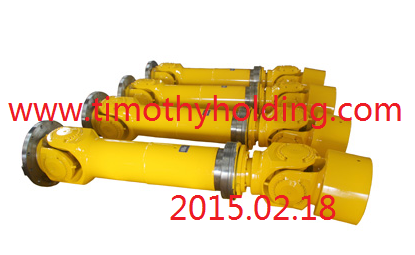
Universal joint couplings serve asessential components in mechanical power transmission systems, widely employedin:

  • Automotive     systems

  • Lifting     and transportation equipment

  • Construction     machinery

  • Industrial     machinery

    Universal joint couplings.png

Common Types of Constant Velocity Joints

  1. Rzeppa (Ball-type) Joints

  2. Double Cardan Joints

  3. Cross-slider Couplings

  4. Disc-type Couplings

These are particularly suitable forconnecting:

  • Intersecting     shafts

  • Parallel     shafts

  • Providing     constant velocity transmission

Advanced Spatial Mechanism Applications

Recent research has developed specializeduniversal joint designs for:

  • Direct     connection of spatial intersecting shafts

  • Large-angle     intersecting shaft connections (with wide variable range)

  • Simplified     manufacturing with fewer components

Critical Application Case: Tube RollingMills

In rolling mill main drive systemsconsisting of:

  • Main     motor

  • Reducer

  • Connecting     shaft

  • Universal     joint coupling

The universal joint coupling represents themost vulnerable mechanical component, where traditional design approaches facedlimitations:

Traditional Design Limitations

  1. Engineering Mechanics     Methods

    • Limited accuracy

    • Poor reliability

  2. Empirical Formula Methods

    • Based on experimental data

    • Required large safety factors

    • Resulted in oversizing and higher costs

Modern Computational Analysis Advancements

With computer technology development,numerical analysis methods have revolutionized design:

Finite Element Method (FEM) Advantages

  • Powerful     computational mathematics approach

  • Widely     adopted in metallurgical equipment design

  • Particularly     effective for complex components like universal joints

  • Provides     practical, reliable and convenient analysis

Modeling Optimization Techniques

Key simplifications in FEM modeling:

  1. Focus on Critical     Components

    • Primarily analyzing the yoke head

    • Simplified modeling of roll-end components

  2. Contact Simulation

    • Independent modeling of:

      • Yoke

      • Jaw

      • Roll-end flange

    • Creation of contact pairs to simulate force transmission

  3. Reasonable Simplifications

    • Ignoring non-load-bearing bolts

    • Omitting minor fillets and rounds

    • Eliminating rigid body displacement

Performance Enhancement Strategies

  1. Precision Manufacturing

    • Improved component geometry

    • Enhanced surface finishes

  2. Material Optimization

    • Advanced alloy selection

    • Heat treatment processes

  3. Maintenance Considerations

    • Lubrication system design

    • Wear monitoring techniques


https://www.timothyholding.com/Universal-Joint-Couplings-Transmission-Components.html