Tuesday, March 31, 2026

Drive Shaft Faults and Maintenance

Drive Shaft Faults and Maintenance


文章附图

Drive Shaft Faults and Maintenance


The drive shaft is a component often overlooked by car owners; we only realize there is a problem when something goes wrong. For example, severe vehicle vibration, or a "clunk" noise when starting or accelerating sharply—these issues should not be taken lightly. Replacing a drive shaft can cost several thousand yuan in the blink of an eye. Therefore, it is essential to master basic knowledge about the drive shaft and universal joints, and more importantly, learn how to maintain the drive shaft of your vehicle.


What is a Drive Shaft


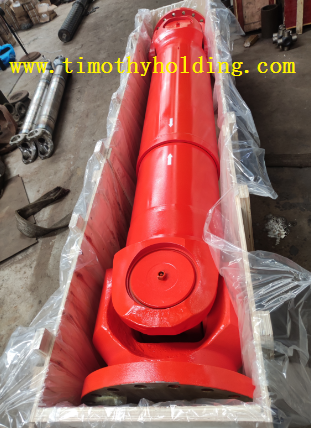
drive shaft consists of a shaft tube, a telescopic sleeve, and universal joints, as shown in the figure below. Together with the transmission and drive axle, it transmits engine power to the wheels, generating driving force for the vehicle.
In some vehicles, the drive shaft is installed between the transmission and the wheel hub, located at the lower front of the vehicle. This position is close to the ground, so mud, sand, and sewage can splash onto the drive shaft surface, making sealing and anti-fouling critical for such drive shafts. During vehicle operation, the wheels move up and down, while the inner end connected to the transmission has minimal movement. To ensure stable power transmission, constant-velocity universal joints are fitted at both ends of the drive shaft. A ball cage universal joint is used on the tire side, and most vehicles adopt a tripod universal joint on the differential side. This type of universal joint features a simple structure and is much cheaper than other designs.

In other vehicles, the drive shaft is mounted between the transmission and the rear axle differential, with better working conditions. However, it is still susceptible to mud, sand, and water accumulation. Such vehicles typically use non-constant-velocity cross-type universal joints or three-joint drive shafts.


drive shaft components.png

Symptoms of Drive Shaft Faults


Wear, deformation, or loss of dynamic balance in drive shaft components will cause abnormal noise and vibration during driving. If you hear a "clunk" sound when starting or accelerating sharply, accompanied by an obvious feeling of loose parts, the drive shaft components are very likely to be worn loose. If a "buzzing" noise comes from the chassis during driving, which becomes louder as speed increases, the drive shaft should be inspected immediately. If it is truly damaged, replacing a drive shaft at a repair shop will cost at least several thousand yuan.


How to Maintain the Drive Shaft


Since replacing a drive shaft is so expensive, how should we maintain it? In fact, careful daily driving can greatly extend its service life. Car owners should avoid turning the steering wheel while the vehicle is stationary, as this overloads the universal joint joints and shortens their lifespan. Also avoid starting in high gear, suddenly releasing the clutch pedal, overloading, and speeding. If possible, regularly inspect the drive shaft’s operating condition: check whether the drive shaft hanger is securely fastened, whether the support rubber is damaged, and whether the drive shaft is deformed.


When removing the drive shaft for maintenance, remember to mark the assembly position on the telescopic sleeve and flange shaft to ensure the original assembly relationship is maintained during reinstallation. Regularly grease the cross bearings of the universal joints to keep your vehicle in good condition for a long time.


Contact Name:August

Mobile Phone:+86-13758897904

E :august@timothyholding.com

Web:www.timothyholding.com

Address:55# Jinshi Road ,Lecheng Industrial Park,Yueqing City,Zhejiang Province,China

Wednesday, February 4, 2026

Heavy-duty Vehicle Drive Shaft


Heavy-duty Vehicle Drive Shaft


Introduction


A drive shaft consists of a shaft tube, a telescopic sleeve, and a universal joint.

The Drive Shaft is a circular component that connects or assembles various parts, while being capable of moving or rotating. It is generally made of lightweight alloy steel tubes with excellent torsional resistance. For front-engine, rear-wheel-drive vehicles, it is the shaft that transmits the rotation of the transmission to the final drive. It can consist of multiple sections connected by universal joints. As a high-speed rotating body with minimal support, its dynamic balance is crucial. Typically, drive shafts undergo dynamic balance testing before leaving the factory and are adjusted on a balancing machine.


Function

The drive shaft is a key component for transmitting power in a vehicle's drive train. Its function, together with the gearbox and drive axle, is to transfer power from the engine to the wheels, enabling the vehicle to generate driving force.


Applications

Special vehicle drive shafts are mainly used in models such as oil tankers, refueling trucks, sprinkler trucks, sewage suction trucks, fecal suction trucks, fire trucks, high-pressure cleaning trucks, road wreckers, aerial work platforms, and garbage trucks.


Structure


Universal Joint


The universal joint is a critical component of a vehicle's drive shaft. A vehicle is a moving object. In rear-wheel-drive vehicles, the engine, clutch, and transmission are mounted as a single unit on the frame, while the drive axle is connected to the frame via elastic suspension. There is a distance between these two assemblies, which requires a connection. During vehicle operation, uneven road surfaces cause jolting.

Heavy-duty Vehicle Drive Shaft,www.timothyholding.com


1. Function:

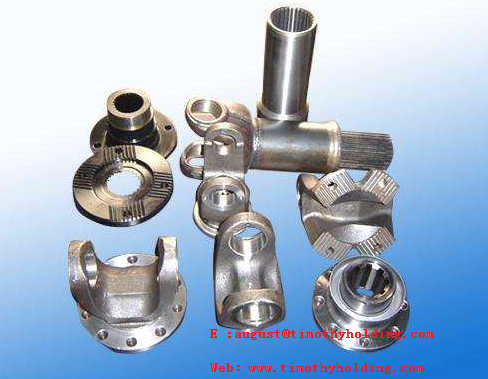
A typical universal joint is composed of a cross shaft, cross bearings, and a flange yoke. It is a key component of the vehicle's drive shaft. In front-engine, rear-wheel-drive vehicles, the universal joint drive shaft is installed between the transmission output shaft and the drive axle final drive input shaft. In front-engine, front-wheel-drive vehicles, the drive shaft is omitted, and universal joints are installed between the front axle half-shafts (which are responsible for both driving and steering) and the wheels. During vehicle operation, uneven road surfaces cause jolting, load changes, or differences in the installation positions of the two assemblies—all of which can alter the angle and distance between the transmission output shaft and the drive axle final drive input shaft. Therefore, a device that "adapts to changes" is needed to solve this problem, leading to the development of the universal joint.


2. Transmission Characteristics:

In front-engine, rear-wheel-drive (or all-wheel-drive) vehicles, suspension deformation during movement causes frequent relative motion between the drive axle final drive input shaft and the transmission (or transfer case) output shaft. Additionally, to avoid certain mechanisms or devices (making linear power transmission impossible), a device is necessary to ensure normal power transmission—hence the emergence of universal joint transmission. Universal joint transmission must meet the following characteristics:

  • a. Reliably transmit power when the relative position of the two connected shafts changes within the expected range;

  • b. Ensure uniform operation of the two connected shafts. The additional load, vibration, and noise caused by the universal joint angle must be within allowable limits;

  • c. High transmission efficiency, long service life, simple structure, easy manufacturing, and convenient maintenance. For vehicles, since the output shaft of a single cross-shaft universal joint rotates at a non-uniform speed relative to the input shaft (when there is a certain angle), a double universal joint (or multi-universal joint) transmission must be used. The two universal joint yokes connected to the same drive shaft should be arranged in the same plane, and the angles of the two universal joints should be equal. This is extremely important. During design, the angle of the universal joint should be minimized as much as possible.

  • Telescopic Sleeve

In the traditional drive shaft structure, the spline sleeve is welded to the flange yoke, and the spline shaft is welded to the drive shaft tube. The new-type drive shaft abandons this traditional structure: instead, the spline sleeve is welded integrally with the drive shaft tube, and the spline shaft is made integrally with the flange yoke. Furthermore, the rectangular-tooth spline is replaced with a large-pressure-angle involute short-tooth spline, which not only enhances strength but also facilitates extrusion forming, meeting the requirements of high-torque working conditions. The tooth surfaces of the telescopic sleeve and spline shaft are fully coated with a layer of nylon material, which not only improves wear resistance and self-lubrication but also reduces damage to the drive shaft caused by impact loads and enhances buffering capacity.

This type of drive shaft adds a tubular sealing protective sleeve outside the flange spline shaft. Two polyurethane rubber oil seals are installed at the end of this protective sleeve, creating a fully sealed space inside the telescopic sleeve. This prevents the telescopic spline shaft from being eroded by external sand and dust, providing both dustproof and rustproof protection. Therefore, during assembly, applying lubricating grease once between the spline shaft and the sleeve fully meets the service requirements. There is no need to install an oil nipple for lubrication, reducing maintenance tasks.


Shaft Bushing

Shaft bushings are designed to reduce friction and wear when the shaft moves. Their basic purpose is similar to that of bearings, and they are relatively cheaper. However, they have higher frictional resistance, so they are only used in some components. Most shaft bushings are made of copper, but plastic ones are also available. Shaft bushings are mostly placed between the shaft and the supporting structure, fitting tightly to the supporting structure—only the shaft can rotate on the bushing. When assembling the shaft and shaft bushing, lubricant is added between them to reduce friction during rotation.

Heavy-duty Vehicle Drive Shaft,www.timothyholding.com


Contact Name:August

Mobile Phone:+86-13758897904

E :august@timothyholding.com

Web:www.timothyholding.com

Address:55# Jinshi Road ,Lecheng Industrial Park,Yueqing City,Zhejiang provice,China

Sunday, January 18, 2026

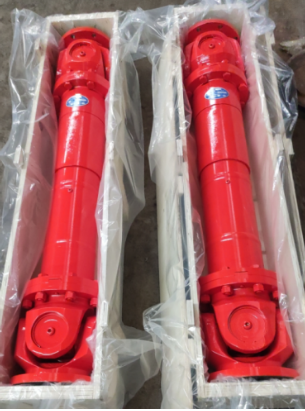
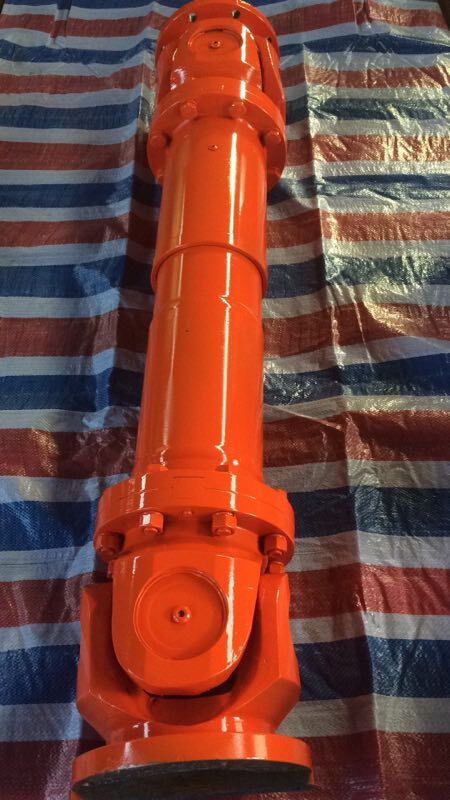
SWC225/250/285/315-BF Type Cardan Shaft


SWC225/250/285/315-BF Type Cardan Shaft


文章附图

SWC225/250/285/315/350/390/440/550/620-BF Flange Type Cardan   Shafts

Product Features:

  1. Compact and reasonable structure. The SWC type adopts an integral yoke, making operation more reliable.

  2. Strong angular compensation capability. The axis deflection angle of the SWC type can reach 15-25 degrees.

  3. Stable operation, low noise, simple assembly, disassembly and maintenance, high transmission efficiency. It is suitable for high-power transmission, featuring energy saving, strong load-bearing capacity and high torque.

Product Material:

  • Regular material: 35CrMo and 20CrMnTi

  • Special customization available according to requirements

Cardan shaft is widely used in rolling mill, punch, straightener, crusher, ship drive, paper making equipment, common machinery, water pump equipment, test bench, and other mechanical applications.

Advantage:
1. Low life-cycle costs and long service life;
2. Increase productivity;
3. Professional and innovative solutions;
4. Reduce carbon dioxide emissions, and environmental protection;
5. High torque capacity even at large deflection angles;
6. Easy to move and run smoothly;

SWC225-BF.pngSWC-BF285-cardan saft.jpg


Contact Name:August

Mobile Phone:+86-13758897904

E :august@timothyholding.com

Web:https://www.timothyholding.com

Address:55# Jinshi Road ,Lecheng Industrial Park,Yueqing City,Zhejiang Province,China