Showing posts with label cold rolling. Show all posts

Sunday, September 8, 2024

Rolling Process For Steel
 

Rolling Process For Steel


文章附图

Steel undergoes the process of rolling to reduce the thickness of the metal as well as make it uniform. In this process, steel is placed between two/multiple rolls where the thickness is altered by manipulating the length direction of the steel rather than the width direction. This is because the point of contact between rolls along the length is much smaller than the width of the steel sheet that is pushed in between. This makes sure that the length of the steel is worked on and the working of the roll along the width is restrained.


Types of rolling

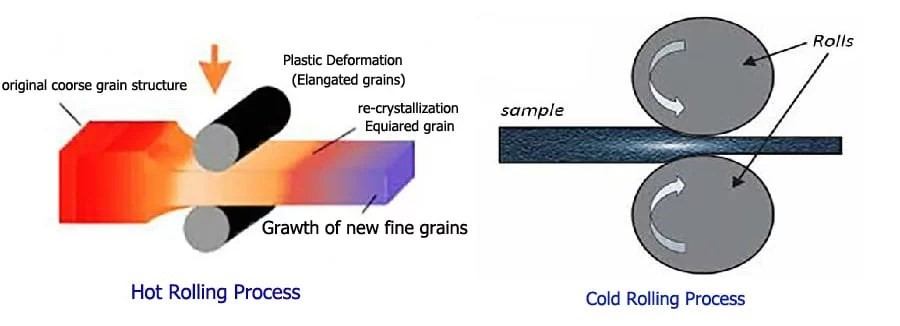
There are two types of rolling process: hot and cold rolling process. The basic distinction between these two processes is the difference in the processing temperature with regards to the recrystallization of the steel. When the processing temperature of the deformation of steel is above the recrystallization temperature, it hot rolling. On the other hand, if the processing temperature is below the recrystallization temperature, it is cold rolling.

Hot rolling process


It makes the steel soft and ductile. The hardness of steel cannot be modified after the hot rolling process. The hardness is related to chemical composition of the metal as well as the rate of cooling. Hot rolling, however, may lead to loss of steel because of oxidation and result in poor surface finish.


Cold rolling process


In case of cold rolling, the hardness is much more than the hot rolling process. This process helps to obtain physical qualities of metal that are usually not obtainable by the hot rolling process. This can eliminate the errors like that of shrinkage. In short, cold rolling results in a final metal sheet that is more accurate in terms of dimensions and properties than the one that is obtained from hot rolling process. The metal sheet has a smoother surface and the strength of the steel is also increased. However, the ductility decreases. The strain makes the steel more brittle. Further, the final metal obtained needs to undergo heating regularly to make it workable.

swc cardan shafts (1).jpg

The basic of rolling process of steel


Both horizontal and vertical stresses caused by the rolls compresses as well as restrain the steel. The rolls exert a vertical stress on the piece of steel and at the same time the price of metal exerts pressure back on the rolls. The rolls are exposed to elastic deformation because of the pressure induced by the piece of metal.

It leads to uneven distribution of thickness of the steel in such a way that the thickness is greater in the center and reduces as it moves along the edges of the metal. A thicker center indicates that the edges of the steel are more elongated. This implies that the edges are subjected to more stress and there is also more tension in the center of the working metal. The uneven thickness can lead to flawed final sheet of steel. It can cause warping, cracking or wrinkling of the steel sheet.

To counter this, back-up rolls are used. Otherwise, you can also use materials like sintered carbide that are high elastic modulus. Sometimes, cambered rolls are also used to counter elastic deflection of rolls. Depending upon the width of steel involved in the rolling and the stress flow, the degree of cambering can be decided. Insufficient cambering or absence of cambering can result in steel that has thicker center. On the other hand, if over cambering happens, it will make the edges thicker than center, which just the exact opposite of insufficient cambering. This can lead to splitting, wrinkling and cracking of edges of the final sheet of steel.

Contact Name:August

Mobile Phone:+86-13758897904

E :august@timothyholding.com

Web:www.timothyholding.com

Address:55# Jinshi Road ,Lecheng Industrial Park,Yueqing City,Zhejiang provice,China

Tuesday, May 14, 2024

Maintenance and Care for Steel Mill Rolls


Maintenance and Care for Steel Mill Rolls

文章附图

Maintenance and Care for Steel Mill Rolls


Proper maintenance and care are essential to maximize the performance and lifespan of steel mill rolls. Regular maintenance practices and effective care routines can help prevent issues and extend the service life of the rolls.


Inspections: Regular inspections of steel mill rolls are crucial to identify any signs of wear, damage, or other issues. Inspections should include visual examinations, measurements, and non-destructive testing techniques to assess the condition of the rolls accurately. Early detection of problems allows for timely repairs or replacements, minimizing downtime and maintaining product quality.

U joint 2.png

Cleaning: Cleaning the rolls is an important maintenance practice to remove contaminants and prevent surface degradation. The cleaning process may involve using specialized cleaning agents or equipment to ensure thorough cleaning without causing any damage to the rolls. Regular cleaning helps maintain the surface finish and performance of the rolls.


Lubrication: Proper lubrication of steel mill rolls is essential to reduce friction and wear during the rolling process. Lubricants help minimize the contact between the rolls and the steel, reducing the risk of surface damage and improving the overall performance of the rolls. The choice of lubricant depends on factors such as the roll material, operating conditions, and specific rolling process.


Roll Grinding and Maintenance: Roll grinding is a maintenance practice that involves removing a small amount of material from the roll surface to restore its shape, dimensions, and surface finish. This process helps eliminate any imperfections or damages that may affect the performance of the rolls. Regular roll grinding can improve the lifespan and performance of steel mill rolls.

U joint 2.jpg

Optimized Cooling: Effective roll cooling is crucial to prevent overheating and maintain the desired product characteristics. Optimizing the cooling system involves ensuring proper water flow, temperature control, and distribution across the roll surface. Adequate cooling helps prevent roll surface degradation and extends the service life of the rolls.

By implementing a comprehensive maintenance and care routine, steel mill rolls can perform optimally, resulting in improved productivity, reduced downtime, and enhanced product quality.

Contact Name:August

Mobile Phone:+86-13758897904

E :august@timothyholding.com

https://www.timothyholding.com

Address:55# Jinshi Road ,Lecheng Industrial Park,Yueqing City,Zhejiang provice,China
Saturday, May 11, 2024

The Role of Steel Mill Rolls in Industrial Metallurgy

The Role of Steel Mill Rolls in Industrial Metallurgy 


 Steel mill rolls are an integral component of the industrial metallurgy process. These rolls play a crucial role in shaping and forming steel products, enabling the transformation of raw materials into the wide array of end products we use in our everyday lives. Without steel mill rolls, the steel industry would not be able to achieve the level of precision and efficiency required for optimal production.
In the world of steel manufacturing, hot-rolling and cold rolling processes are used to shape and form steel. The function of steel mill rolls varies depending on the specific process. In hot rolling, steel mill rolls are used to reduce the thickness of steel slabs or billets while increasing their length. This process involves applying enormous pressure and heat to the steel, and the rolls must be able to withstand these extreme conditions. Cold rolling, on the other hand, involves passing steel through a series of rolls to achieve the desired thickness, surface finish, and dimensional accuracy.
Steel mill rolls are designed to withstand the rigors of repetitive use and extreme conditions. They are made from high-quality materials such as forged steel, cast steel, or even tungsten carbide, which offer exceptional strength, durability, and resistance to wear and tear. These rolls are engineered to deliver consistent results, ensuring that the steel products meet the required specifications. The precision and reliability of steel mill rolls are crucial in maintaining the productivity and quality standards of the steel industry. 

 Contact Name:August 
 Mobile Phone:+86-13758897904 
 E :august@timothyholding.com 
 Address:55# Jinshi Road ,Lecheng Industrial Park,Yueqing City,Zhejiang provice,China